

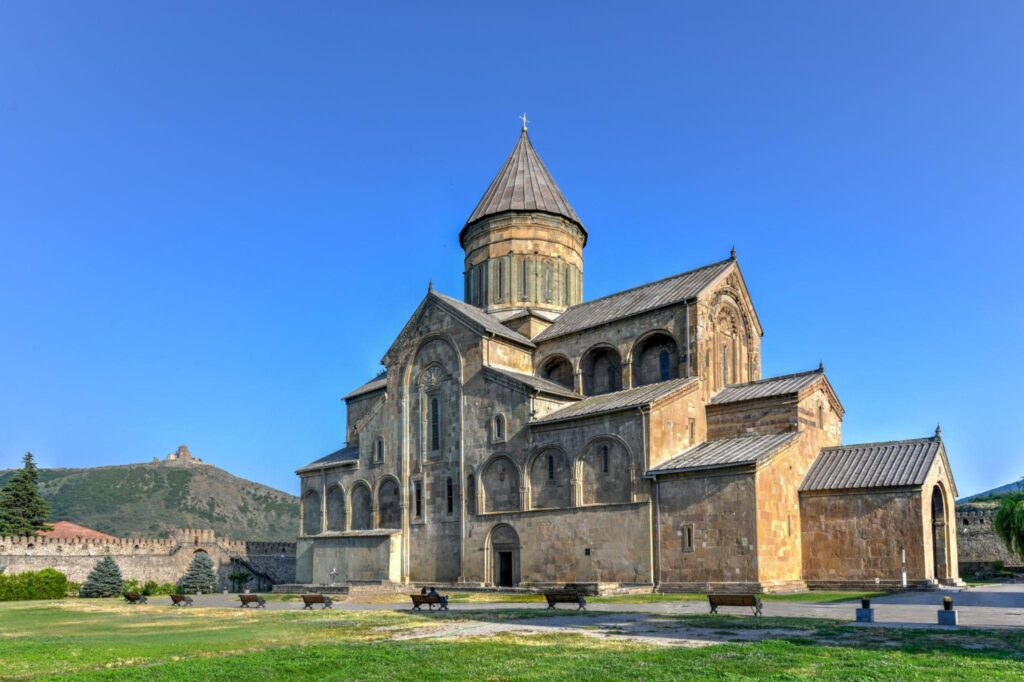
Svetitskhoveli Cathedral
Svetitskhoveli Cathedral — The Living Heart of Georgian Christianity
In the heart of the ancient city of Mtskheta stands Svetitskhoveli Cathedral, one of Georgia’s most sacred and historically significant monuments.
For nearly a thousand years, its monumental stone walls have witnessed royal ceremonies, religious celebrations, and defining moments in the nation’s history. Yet the cathedral’s spiritual story reaches back even further, to the earliest traditions of Christianity in Georgia.
With its elegant proportions, richly carved stone façades, and profound religious symbolism, Svetitskhoveli represents an extraordinary union of faith, architecture, and Georgian national identity.
From the Holy Robe to the Life-Giving Pillar
According to Georgian Christian tradition, the story of Svetitskhoveli begins in the first century, when a Jewish inhabitant of Mtskheta named Elioz brought the robe of Jesus Christ from Jerusalem to Georgia.
Tradition holds that his sister Sidonia died while embracing the sacred garment and was buried with it. A cedar tree later grew over her grave.
During the fourth century, following the conversion of the Kingdom of Iberia to Christianity, King Mirian III ordered the construction of a church on the site.
According to the traditional account, one of the wooden pillars fashioned from the cedar tree rose miraculously and became associated with divine healing.
The name Svetitskhoveli means “Life-Giving Pillar”, preserving the memory of this sacred tradition.
A Masterpiece of Medieval Georgian Architecture
The present cathedral was constructed between 1010 and 1029 under the direction of the architect Arsukidze, during the reign of King George I.
Its monumental cross-in-square design, soaring dome, and carefully proportioned interior represent one of the highest achievements of medieval Georgian architecture.
The exterior façades are decorated with intricate stone carvings, ornamental crosses, and symbolic compositions that reflect the artistic sophistication of eleventh-century Georgia.
Over the centuries, the cathedral has undergone restoration and modification, while retaining its essential architectural character.
What to Discover at Svetitskhoveli
The Monumental Cathedral
Admire the grand proportions of the eleventh-century church, its distinctive dome, and the finely carved details of its stone façades.
The Life-Giving Pillar
Discover the sacred traditions surrounding the original wooden pillar and the symbolic structure within the cathedral associated with the Holy Robe.
Royal Tombs
Svetitskhoveli served as an important burial place for Georgian monarchs. Among those associated with the cathedral are King Vakhtang Gorgasali and King Erekle II.
Frescoes and Religious Art
Explore surviving wall paintings and religious imagery representing different periods of Georgian ecclesiastical art.
The Cathedral Complex
Walk around the cathedral’s historic enclosure, surrounded by stone walls and architectural elements that reflect the site’s long and complex history.
A UNESCO World Heritage Monument
Svetitskhoveli Cathedral forms part of the Historical Monuments of Mtskheta, inscribed on the UNESCO World Heritage List in 1994.
Its significance extends beyond its architectural beauty. As one of the principal sacred places of the Georgian Orthodox Church, it continues to play an important role in the country’s religious and cultural life.
For visitors, Svetitskhoveli offers a rare opportunity to experience a monument where medieval history and living spiritual traditions remain inseparable.
Visiting Svetitskhoveli Cathedral
- Location: Mtskheta, Georgia
- Region: Mtskheta-Mtianeti
- Category: Monasteries & Churches
- Construction: 1010–1029
- Architect: Arsukidze
- UNESCO Status: World Heritage Site
- Recommended Visit: Approximately 45–60 minutes
- Highlights: Medieval architecture, sacred traditions, royal tombs, frescoes, stone carvings
Svetitskhoveli is an active Orthodox cathedral. Modest clothing and respectful behaviour are expected. Access to certain areas may be restricted during religious services.